
SOAR Training: Hands One-Steps
This week our attention turns to Hands One-Steps (Il Soo Sik Soo Ki).
One-steps are far more than memorized sequences for belt testing. They are laboratories where we learn to transform the techniques found in our hyungs into practical self-defense. Every block, strike, stance, and angle has a purpose, and one-steps teach us how those individual movements connect into a complete response against an attacker.
Our hyungs provide the vocabulary of Tang Soo Do. They develop balance, power generation, breathing, timing, precision, and body mechanics. When you perform a form, you are rehearsing the principles that generations of martial artists have preserved.
Our one-steps teach us the grammar. They show us how those same movements interact with another person. Distance, timing, footwork, control, and proper angles suddenly become just as important as the technique itself. A perfect block in the air means very little if you cannot apply it against a moving opponent.
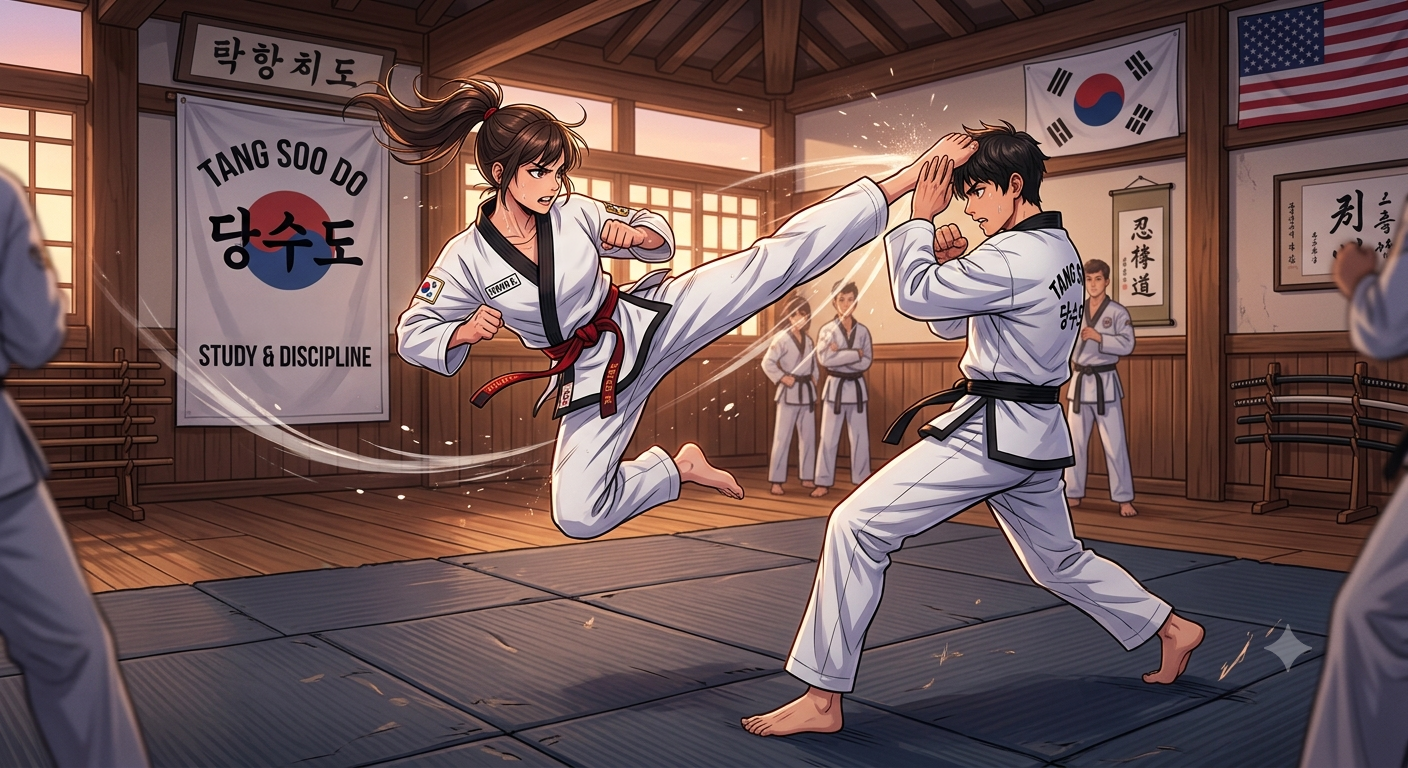
Finally, dynamic application is the conversation. Real self-defense is rarely identical to a memorized one-step. An attacker may move differently, change distances, or continue attacking after the first exchange. Dynamic application challenges us to recognize the principles behind the technique rather than merely remembering the sequence. We adapt, flow, and respond while remaining grounded in the fundamentals taught by our forms and refined through one-steps.
As we practice this week, ask yourself these questions:
- Where does this movement appear in my hyungs?
- What principle is this one-step teaching?
- How could this same principle be applied from a different stance, angle, or distance?
- What changes if I am standing, kneeling, seated, or protecting someone beside me?
Don’t rush through the techniques. Focus on crisp fundamentals, proper distancing, strong stances, decisive movement, and controlled finishes. Speed will come naturally as your mechanics improve.
The goal is not simply to remember thirty one-steps. The goal is to understand why they work.
When forms, one-steps, and dynamic application come together, Tang Soo Do becomes more than a collection of techniques—it becomes a living martial art.
Your Attitude Determines Your Altitude. SOAR!


