
SOAR Challenge: Walking Planks

Core Stability • Shoulder Control • Fighting Posture
Challenge Due: Tuesday, August 18, 2026
Strong martial artists must remain stable while their arms and legs are moving.
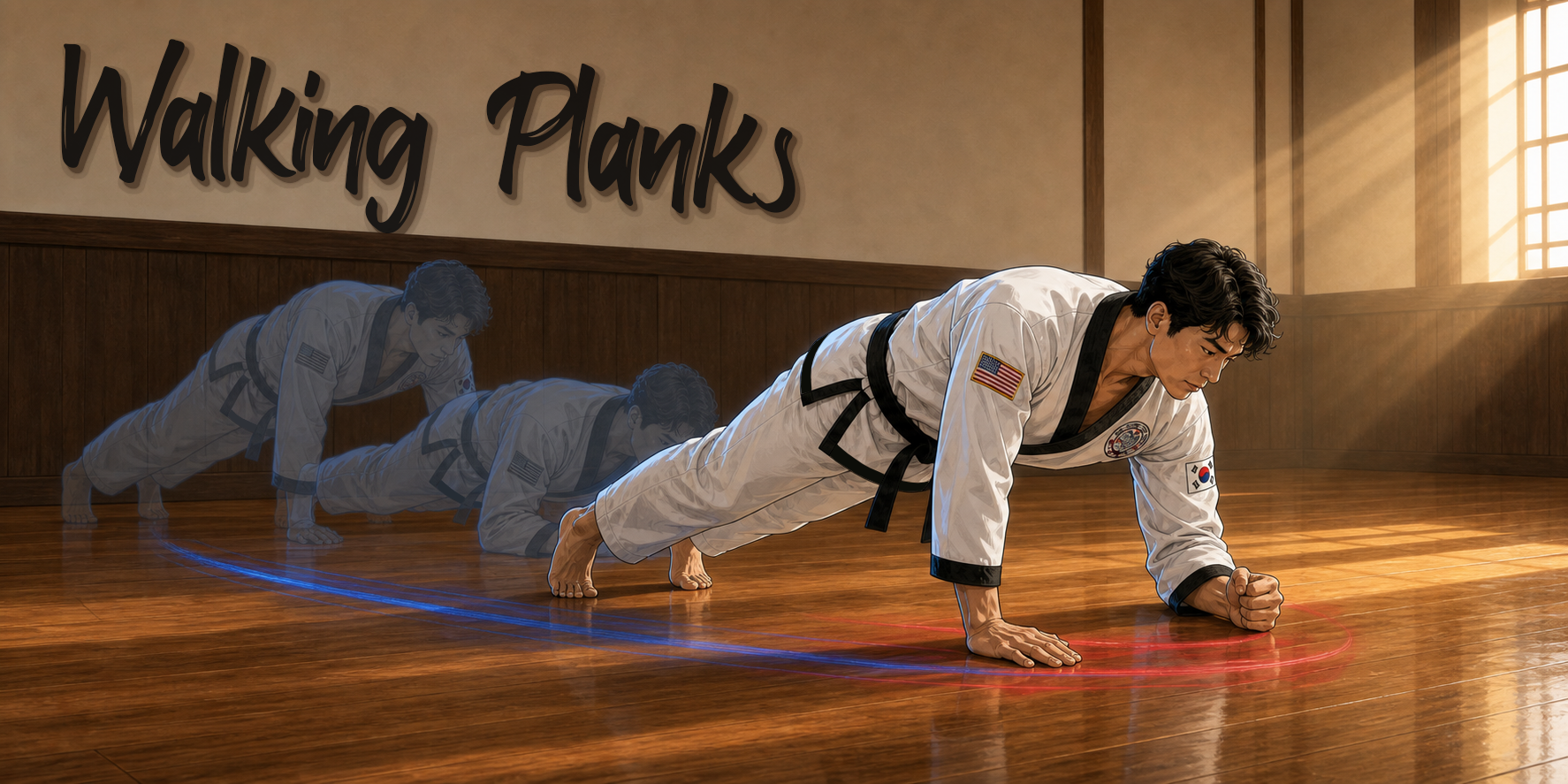
Walking Planks challenge you to maintain a disciplined plank while transitioning from your hands to your forearms and back again. The movement is simple, but controlling your shoulders, hips, and spine becomes difficult as fatigue builds.
That is the challenge. Do not race through careless repetitions. Move deliberately, keep your body aligned, and stop each set before your technique breaks down.
Train with purpose. Train with control. Rise Up!
Coach’s Tips
- Begin in a high plank with your hands directly beneath your shoulders.
- Keep a straight line from your head through your hips to your heels.
- Lower one arm at a time until both forearms are on the floor.
- Press back into the high plank one hand at a time.
- Alternate the leading arm after every repetition.
- Keep your shoulders and hips facing the floor. Do not twist from side to side.
- Brace your abdomen and squeeze your glutes to prevent your lower back from sagging.
- Keep breathing throughout the movement.
- Use a firm, nonslip surface.
- One repetition is high plank → low plank → high plank.
- If wrist, elbow, shoulder, or lower-back pain develops, stop. Use an incline or knee-supported modification when appropriate.
- Quality overrides quantity.
Why This Matters
Walking Planks require the trunk to remain stable while the arms change position. This develops core control, shoulder stability, coordination, and the ability to resist unwanted rotation.
In Tang Soo Do, those qualities help students maintain posture while punching, blocking, changing stances, recovering from techniques, and protecting their guard under fatigue.
The objective is not simply to move up and down. The objective is to control the body while its base of support changes.
A student who can remain composed during a difficult transition is better prepared to remain composed during demanding martial movement or a demanding circumstance.
Rise Up!
Strength is not always demonstrated through dramatic movement. Sometimes strength is the ability to hold your position while everything else is changing.
Keep your hips steady. Keep your breathing controlled. Complete each transition with purpose. Do not allow fatigue to decide the quality of your technique. Your standard matters most when maintaining it becomes difficult.
Your Attitude Determines Your Altitude. SOAR!
🥉 Bronze Tier: White and Orange Belts
Complete
100 Walking Planks
Complete the challenge over at least three training days:
- Day 1: 35
- Day 2: 35
- Day 3: 30
Incline and knee-supported Walking Planks count when they are the appropriate training level.
Focus
- Learning the transition
- Maintaining a straight body line
- Keeping the hips controlled
- Alternating the leading arm
🥈 Silver Tier: Green and Brown Belts
Complete
140 Walking Planks
Complete the challenge over at least four training days:
- Day 1: 35
- Day 2: 35
- Day 3: 35
- Day 4: 35
Use a full plank unless a readiness-based modification is necessary.
Focus
- Smooth transitions
- Minimal hip rotation
- Consistent breathing
- Equal work from both arms
🥇 Gold Tier: Red and Blue Belts
Complete
200 Walking Planks
Complete 40 repetitions on five training days.
Every repetition must be deliberate. Pause and reset whenever your hips begin to rotate or your lower back loses alignment.
Optional Body Saw Progression
Complete 3 sets of 16 Body Saws during the week.
From a forearm plank, move your body backward a few inches and return to the starting position without allowing your lower back to arch. One backward-and-forward cycle counts as one repetition.
Focus
- Anti-rotation control
- Shoulder stability
- Technical consistency under fatigue
- Deliberate pacing
⚫ Master’s Tier: Black Belts
Complete
- 200 Walking Planks
- 50 Body Saws
Complete the work over at least five training days:
- 40 Walking Planks
- 10 Body Saws
Repeat that combination on each training day.
For Body Saws, use sliders or folded towels only on a smooth, controlled surface. A bodyweight rocking variation may be used when sliding equipment is unavailable. From a forearm plank, move your body backward a few inches and return to the starting position without allowing your lower back to arch. One backward-and-forward cycle counts as one repetition.
Leadership Standard
Demonstrate five technically precise Walking Planks for another student and help that student identify:
- Proper shoulder position
- A stable hip line
- The appropriate individual modification
Black-belt leadership means demonstrating judgment, control, and concern for the development of others. It does not mean forcing the greatest number of repetitions.
Focus
- Technical excellence
- Advanced anti-extension control
- Readiness-based judgment
- Leadership through example
Weekly Challenge Reminder
- Record your repetitions.
- Alternate your leading arm.
- Use the variation appropriate for your current readiness.
- Encourage another SOAR student.
- Complete the challenge by Tuesday, August 18.
Complete the challenge. Encourage another student. Grow stronger together.
Your Attitude Determines Your Altitude. SOAR!


