
SOAR Challenge:

Strength • Mobility • Multiplanar Control
Challenge due: Tuesday, October 27, 2026
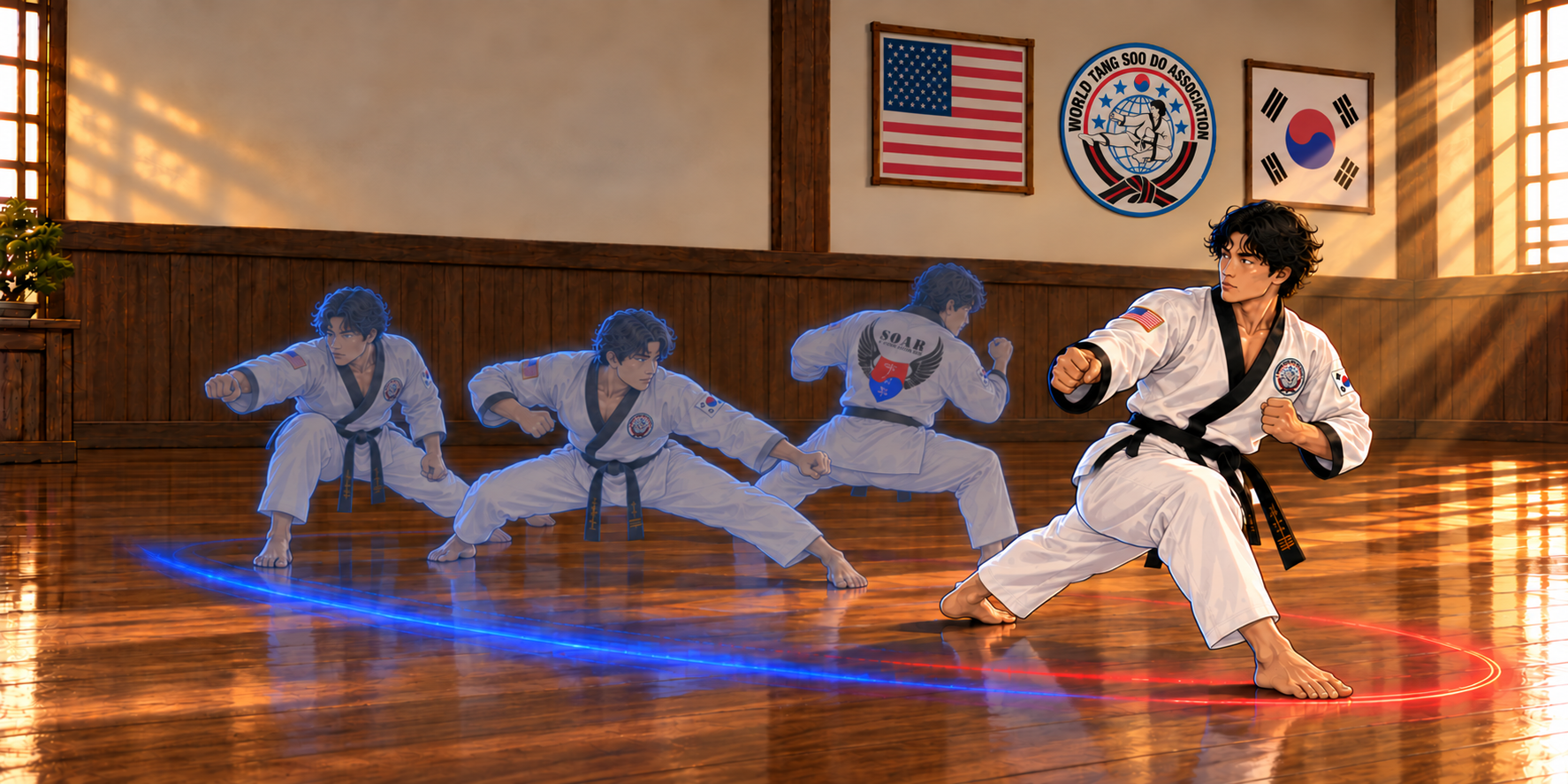
The Lunge Matrix trains the legs and hips to create strength in more than one direction. Instead of repeating only a forward step, the practitioner moves forward, laterally, backward, and through a controlled turn. Each direction begins from balance and ends with a deliberate return to the starting position.
Tang Soo Do requires us to advance, retreat, move sideways, change angles, and recover our stance without losing posture or control. This challenge develops those abilities through a readiness-based bodyweight exercise. The goal is not to reach the deepest lunge or finish the most repetitions. The goal is to own every step, keep the knee aligned with the foot, and return to balance without rushing.
Remember: students must complete six weekly challenges during each testing cycle.
Coach’s Tips
- Use a clear, nonslip training area. Keep enough space open in front, behind, and to both sides.
- Warm up with easy walking, ankle circles, controlled knee bends, hip movement, and short practice steps in each direction.
- Begin every repetition from a tall, balanced stance. Brace the trunk and keep the head aligned over the torso.
- One complete matrix includes four lunges on the right and four on the left: forward, lateral, reverse, and rotational. That is eight lunges total.
- Step only as far as you can control. The working knee should follow the direction of the foot rather than collapsing inward or twisting away from it.
- In the forward and reverse lunges, keep the front foot planted and lower only through a comfortable range. The rear knee does not need to touch the floor.
- In the lateral lunge, step to the side, bend the stepping knee, and allow the hips to travel back while the other leg remains comfortably long. Keep both feet supported and do not force the straight leg.
- In the rotational lunge, turn and step on a comfortable diagonal. Let the stepping foot, knee, hips, and torso change direction together. Do not twist over a foot that is trapped against the floor.
- Push through the whole foot to return to the starting position. Reestablish balance before beginning the next direction.
- Use a wall, chair, barre, or partner-provided hand target for light balance support when needed.
- A shorter step, reduced depth, or supported split-stance weight shift counts. Depth and volume must match current readiness rather than belt rank.
- Reduce the total number of matrices when soreness, fatigue, mobility limits, or recent training makes the assigned volume inappropriate.
- Stop for sharp pain, joint pressure, numbness, tingling, dizziness, or an unsafe loss of balance. Quality overrides quantity.
Why This Matters
Forward and reverse lunges develop control as the body travels ahead of and behind its starting position. Lateral lunges add side-to-side strength and hip mobility. Rotational lunges ask the feet, knees, hips, and trunk to organize around a change of direction.
Together, these patterns challenge unilateral leg strength, balance, ankle stability, and controlled hip motion. Those qualities support more dependable stance transitions and directional changes. The benefit does not come from forcing a large range. It comes from maintaining alignment while entering the position, controlling the bottom, and recovering to balance.
Rise Up!
Move forward without falling forward. Move backward without retreating from control. Move sideways and turn without losing your foundation.
Every direction should finish where it began: balanced, organized, and ready.
Bronze Tier: White & Orange Belts
Complete three sessions on separate days.
During each session, complete 2 full matrices—16 lunges per session and 48 lunges for the week.
- Practice one direction at a time and reset your stance after every repetition.
- Use light support, a short step, or reduced depth as needed.
- Pause briefly after returning to the starting position before changing direction.
Focus: Learn the four directions, keep the knee aligned with the foot, and recover balance after every step.
Silver Tier: Green & Brown Belts
Complete three sessions on separate days.
During each session, complete 3 full matrices—24 lunges per session and 72 lunges for the week.
- Pause for one second at a controlled depth in every lunge.
- Return to a stable stance before beginning the next direction.
- Use consistent step length and depth on the right and left whenever mobility permits.
Focus: Bilateral control, dependable alignment, and smooth movement through forward, lateral, reverse, and rotational patterns.
Gold Tier: Red & Blue Belts
Complete four sessions on separate days.
During each session, complete 3 full matrices—24 lunges per session and 96 lunges for the week.
- Complete two standard matrices and one precision matrix during each session.
- In the precision matrix, take three seconds to enter each lunge, pause for one second, and return under control.
- Maintain a disciplined guard or composed ready-hand position without using the arms to disguise loss of balance.
Focus: Tempo control, symmetrical range, coordinated changes of direction, and stable recovery under accumulating fatigue.
Master’s Tier: Black Belts
Complete the Gold Tier workload and lead through technical excellence.
- During one session, complete an assessed precision matrix. Ask a qualified practitioner to observe foot placement, knee tracking, trunk organization, and balance during the return—or record specific self-observations immediately afterward.
- During one session, complete one eyes-forward balance matrix in which the gaze remains level rather than following the feet. Use only a range that remains safe and controlled.
- Coach one student through a readiness-appropriate matrix. Help the student improve one specific relationship among the foot, knee, hip, and trunk without increasing depth prematurely.
Focus: Refined control, honest assessment, readiness-based judgment, and leadership through clear, patient instruction.
Complete the challenge. Encourage another student. Grow stronger together.
Your Attitude Determines Your Altitude. SOAR!


