
SOAR Challenge: Splits II — Active Flexibility

Usable Range • Leg Strength • Kicking Control
Challenge Due: Tuesday, December 1, 2026.
DO NOT FORGET: YOU NEED TO COMPLETE SIX CHALLENGES FOR EACH TESTING CYCLE.
The first Splits Challenge asked you to practice supported positions patiently. This week asks a different question: can you lift, hold, and lower your leg through a range you control yourself?
A high kick is not made useful by height alone. Balance, posture, a dependable supporting leg, and a controlled return matter just as much. Splits II develops active flexibility with low, deliberate front and side leg raises. This is conditioning for usable range, not a test of how high you can force your leg.
Coach’s Tips
- Warm up for 5–10 minutes with easy movement, stance transitions, gentle hip motion, and a few low practice raises. Do not begin at your highest range.
- Use a clear, nonslip area. Keep a wall, chair, or barre within reach. Light hand support is permitted at every tier.
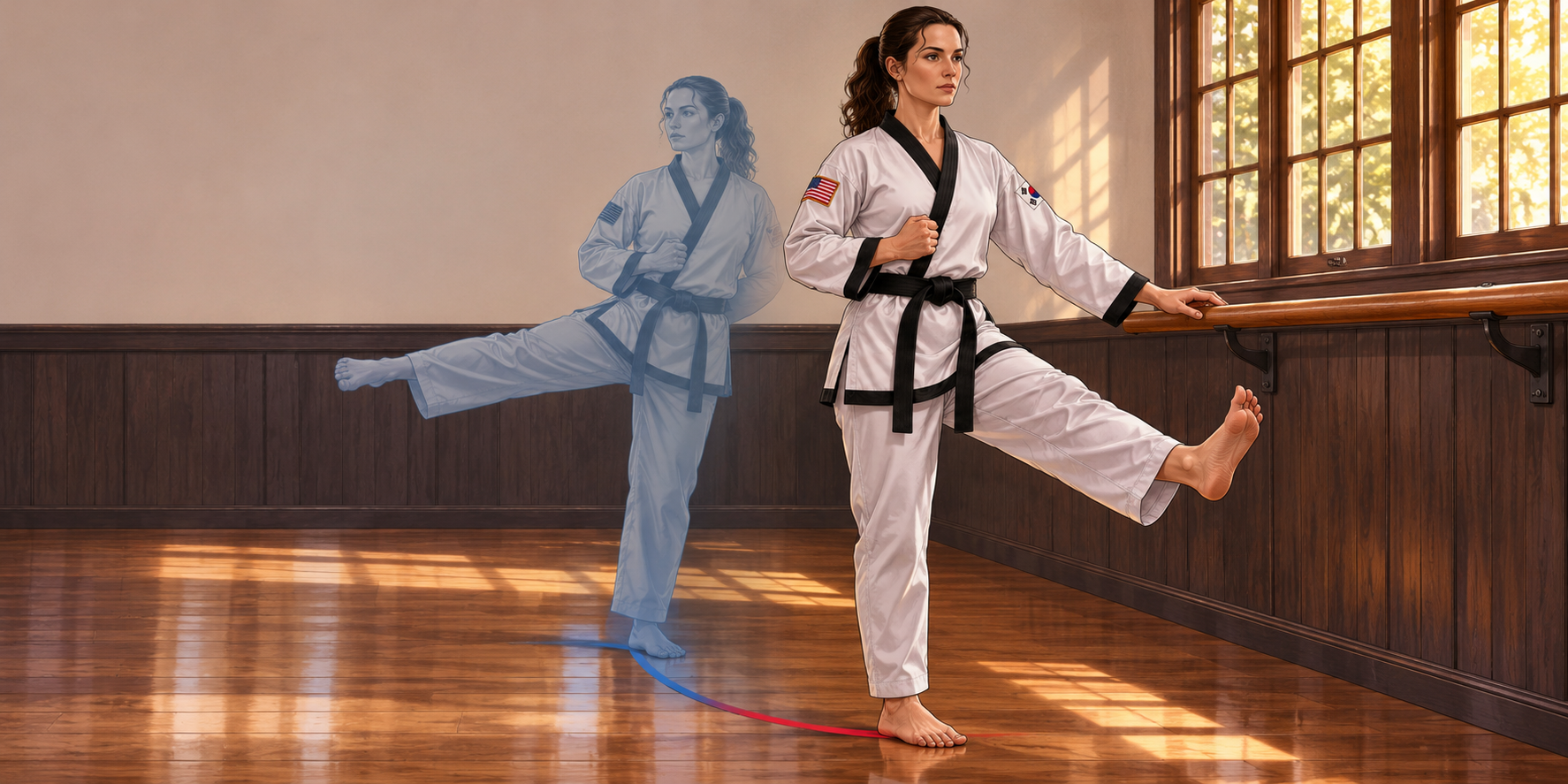
- Begin standing tall with the supporting knee softly flexed. Lift one leg forward through a comfortable range, pause as assigned, and lower it slowly without dropping it. Repeat to the side. Train both legs.
- Keep the pelvis and trunk controlled. A small adjustment for balance is normal; leaning, twisting a planted knee, or swinging the leg to gain height is not.
- Keep the moving knee comfortably extended without locking it. Choose a lower range if the back rounds, the supporting heel rises, or the leg cannot be lowered smoothly.
- These raises are controlled conditioning movements, not substitutes for the front- or side-kick mechanics taught in class. Do not snap the knee or chase a striking height.
- One repetition is one lift and controlled return. Count front and side raises separately. Rest between sets as needed.
- Reduce height, repetitions, sets, or speed when fatigue changes the movement. Use support or a smaller range regardless of belt rank.
- Stop for sharp pain, joint pressure, numbness, tingling, dizziness, or an unsafe loss of balance. Follow any existing medical restrictions.
Quality overrides height and quantity.
Why This Matters
Passive range is the space your body can reach with help. Active range is the space you can enter and leave through your own muscular control. The two are related, but they are not identical.
Front and side leg raises ask the moving leg to work while the standing leg, hips, and trunk maintain balance. Slow lowering makes the return part of the exercise. That matters in Tang Soo Do: after a leg moves toward a target, the practitioner still needs control to recover position and continue.
This challenge follows the patient approach of the first Splits Challenge. It does not promise a full split or a higher kick in one week. It asks you to build strength in the range you can use today.
Rise Up!
Do not borrow height from momentum. Own the range you have. Lift with purpose. Pause with control. Return ready.
Bronze Tier: White & Orange Belts
Complete three sessions on separate days. In each session, perform 2 sets of 4 front raises and 4 side raises per leg.
Lift smoothly, pause briefly, and lower under control. Reset your stance after each repetition. Use light support and a low range whenever they improve balance.
Focus: Learn the path of each movement and keep the standing leg dependable.
Silver Tier: Green & Brown Belts
Complete three sessions on separate days. In each session, perform 2 sets of 6 front raises and 6 side raises per leg.
Pause for approximately one second at the highest controlled point of each raise. Lower without allowing the foot to fall. Match the quality of both sides, even if their available ranges differ.
Focus: Consistent posture, bilateral practice, and an unhurried return.
Gold Tier: Red & Blue Belts
Complete four sessions on separate days. In each session, perform 2 sets of 6 front raises and 6 side raises per leg.
Pause for two seconds at a height that allows the trunk to stay organized. During the second set, take approximately three seconds to lower each repetition. Use support if it preserves alignment.
Focus: Strength near the edge of usable range, controlled lowering, and consistency across the week.
Master’s Tier: Black Belts
Complete the Gold Tier workload and lead through technical excellence. The following control work is part of the assigned repetitions, not additional volume.
- In one set each session, observe whether the supporting foot, knee, pelvis, trunk, and guard remain organized as the leg rises and returns.
- Once during the week, ask a qualified practitioner to assess a set, or record specific self-observations immediately afterward. Note the highest controlled range for each leg and direction.
- Coach one student through a readiness-appropriate version. Help the student improve one observable detail without pushing for greater height or removing needed support.
Focus: Honest assessment, precise movement, intelligent scaling, and patient leadership.
Complete the challenge. Encourage another student. Grow stronger together.
Your Attitude Determines Your Altitude. SOAR!


