
SOAR Challenge: Splits

Flexibility • Patience • Controlled Range
Challenge Due: October 6, 2026
A split is not a position to force. It is a direction of training.
This week’s challenge develops the flexibility that supports longer stances, higher kicks, smoother chambers, and freer movement through the hips. Students will practice front-split and middle-split progressions at a depth appropriate for their present mobility.
The goal is consistent, patient practice. Your success is measured by completing technically controlled sessions—not by reaching the floor.
Warm up first. Move gradually. Breathe. Stop before discomfort becomes pain.
Train with patience. Train with control. Rise Up!
Coach’s Tips
- Complete at least 5–10 minutes of light movement before beginning: walking, easy jogging, stance transitions, or another instructor-approved warm-up.
- Follow the warm-up with controlled dynamic movements such as leg swings or hip openers. Do not begin with a deep static split.
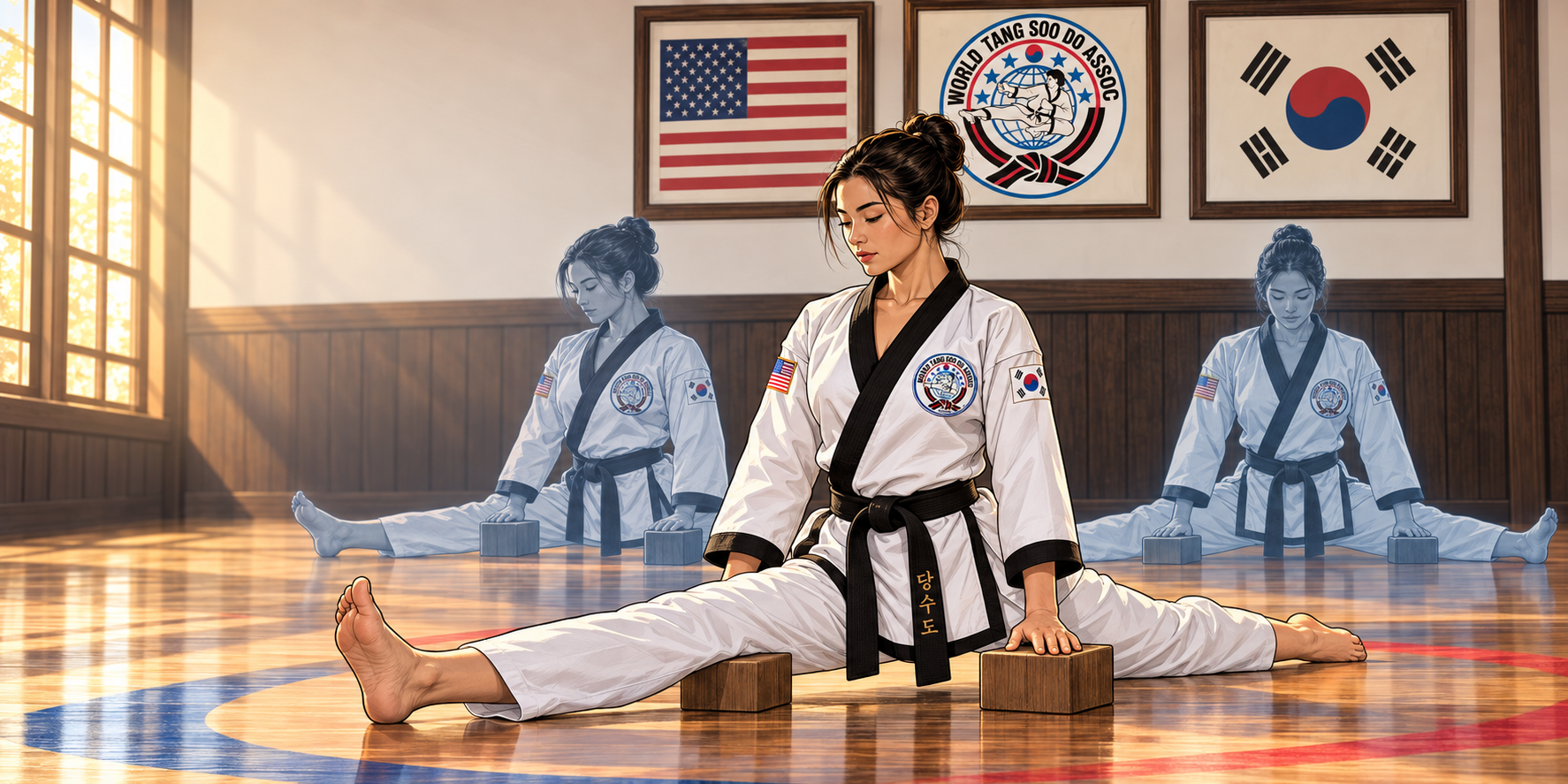
- Practice both a front-split progression and a middle-split progression. Use blocks, a chair, the wall, or the floor for support as needed.
- For the front-split progression, keep the front knee and toes directed upward or forward as instructed, square the hips as much as your current range permits, and practice both legs forward.
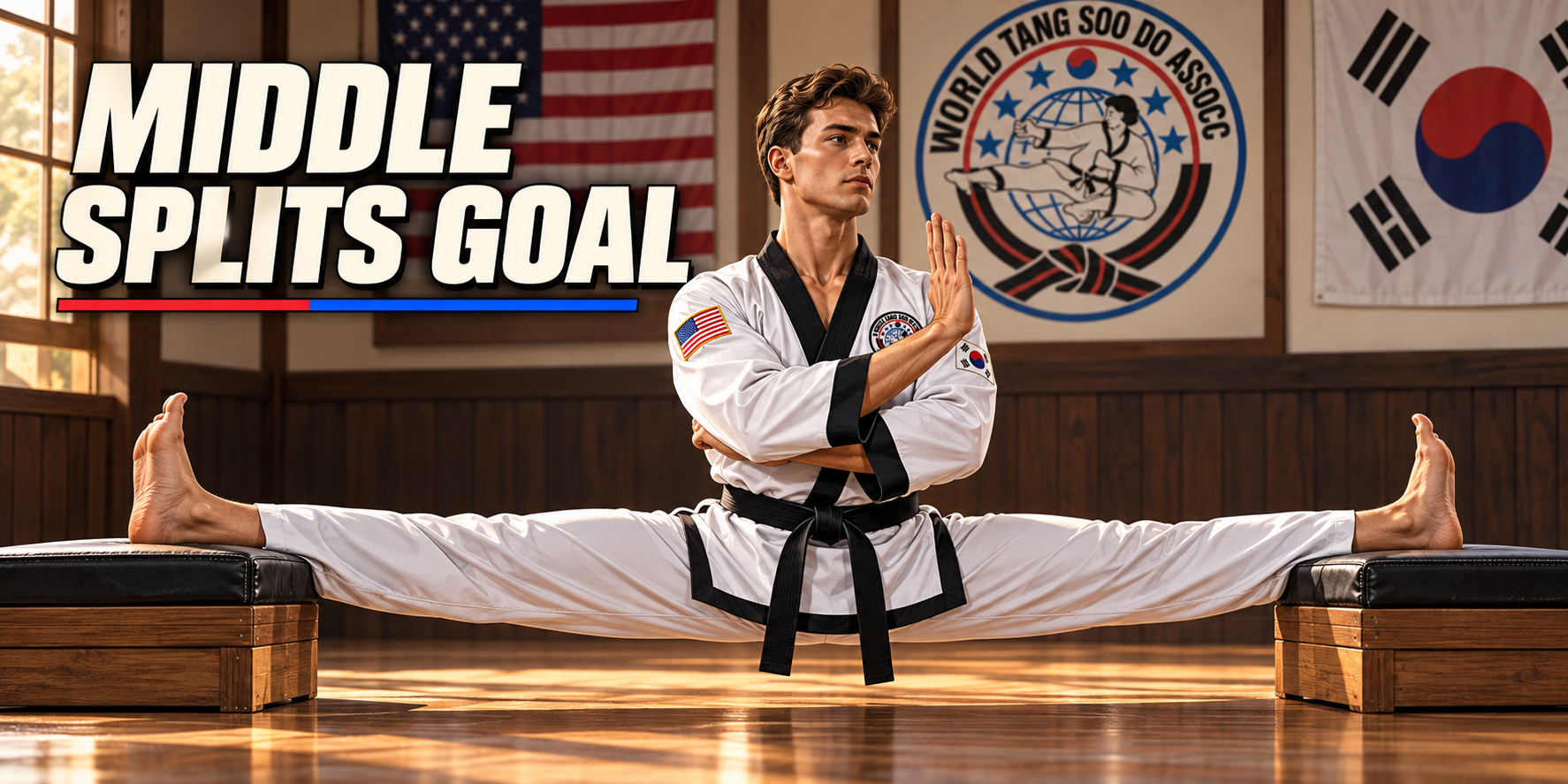
- For the middle-split progression, keep the knees and toes aligned according to the chosen variation. Do not allow the knees to collapse or twist merely to move lower.
- Lower only until you feel a strong but manageable stretch in the muscles. Joint pressure, sharp pain, numbness, tingling, or a sense of tearing means STOP and to come out of the position.
- Do not bounce. Enter and leave each stretch slowly.
- Keep breathing. Exhale without forcing additional depth.
- A supported, reduced-range position counts. Depth is based on readiness, not belt rank.
- Hold times begin only after a stable, pain-free position is established.
- Rest briefly between holds. Stop the session when control or alignment deteriorates.
- Do not compare your depth with another student. Quality overrides depth and quantity.
Why This Matters
Tang Soo Do asks the hips and legs to move through large ranges while the practitioner maintains balance and posture. Flexible hamstrings, hip flexors, adductors, and surrounding tissues can make it easier to establish longer stances and move the kicking leg without compensating through the lower back or supporting knee.
Flexibility develops gradually. A single aggressive session cannot replace repeated, controlled practice. This challenge rewards the habit of returning to the work, respecting the body’s current limit, and letting range improve over time.
In other words, this challenge is different from the others. This challenge is an introduction that you should incorporate into your normal weekly workout routine. I recommend placing the static splits exercise at the end of your workout as the beginning of your cool-down stretches.
The split is a useful training direction, but it is not a universal finish line. A technically sound supported progression is better than a deeper position reached through twisting, bouncing, or pain.
Rise Up!
Progress in flexibility can be difficult to see from one day to the next.
That is why patience matters.
Return to the position. Breathe. Maintain your alignment. Let consistency do the work that force cannot.
Your range today is your starting point—not your value as a martial artist.
Your Attitude Determines Your Altitude. SOAR!
Bronze Tier: White and Orange Belts
Complete three flexibility sessions on separate days.
During each session, complete:
- Front-split progression: 2 holds × 20 seconds with the right leg forward
- Front-split progression: 2 holds × 20 seconds with the left leg forward
- Middle-split progression: 2 holds × 20 seconds
Use as much hand or block support as needed. A short stance or high supported position counts.
Focus
- Learning safe positions
- Equal practice on both sides
- Smooth breathing
- Entering and leaving under control
Silver Tier: Green and Brown Belts
Complete four flexibility sessions on separate days.
During each session, complete:
- Front-split progression: 2 holds × 30 seconds with the right leg forward
- Front-split progression: 2 holds × 30 seconds with the left leg forward
- Middle-split progression: 2 holds × 30 seconds
Use support whenever it improves alignment. Move only to a depth that can be held without bouncing or joint strain.
Focus
- Consistent hip and knee alignment
- Relaxed breathing under tension
- Symmetrical practice
- Controlled depth
Gold Tier: Red and Blue Belts
Complete five flexibility sessions on separate days.
During each session, complete:
- Front-split progression: 3 holds × 30 seconds with the right leg forward
- Front-split progression: 3 holds × 30 seconds with the left leg forward
- Middle-split progression: 3 holds × 30 seconds
After the final hold in each direction, rise out of the position slowly without dropping, bouncing, or using momentum.
Focus
- Patient time under stretch
- Stable posture at a challenging range
- Controlled transitions
- Consistency across five sessions
Master’s Tier: Black Belts
Complete five flexibility sessions on separate days.
During each session, complete the Gold Tier holds, then add:
- Two 10-second submaximal isometric contractions in each front-split progression
- Two 10-second submaximal isometric contractions in the middle-split progression
For each contraction, remain in a supported position and gently press the feet or legs into the floor without moving. Use moderate effort; this is controlled tension, not a maximum test. Relax fully before the next hold. Omit the contractions when pain, injury, or training readiness makes them inappropriate.
Leadership Standard
Help one student choose an appropriate support and depth. Reinforce breathing, alignment, and the difference between muscular stretch and joint pain. Do not press, pull, or push another student deeper without direct instructor supervision. Allow gravity and relaxation to draw your splits deeper.
Focus
- Technical control near end range
- Responsible use of muscular tension
- Readiness-based judgment
- Leadership through patient instruction
Complete the challenge. Encourage another student.
Grow stronger together.
Your Attitude Determines Your Altitude.
SOAR!


