
SOAR Challenge: Shin-Box Transitions

Hip Rotation • Ground Mobility • Postural Control
Challenge due: Tuesday, November 10, 2026
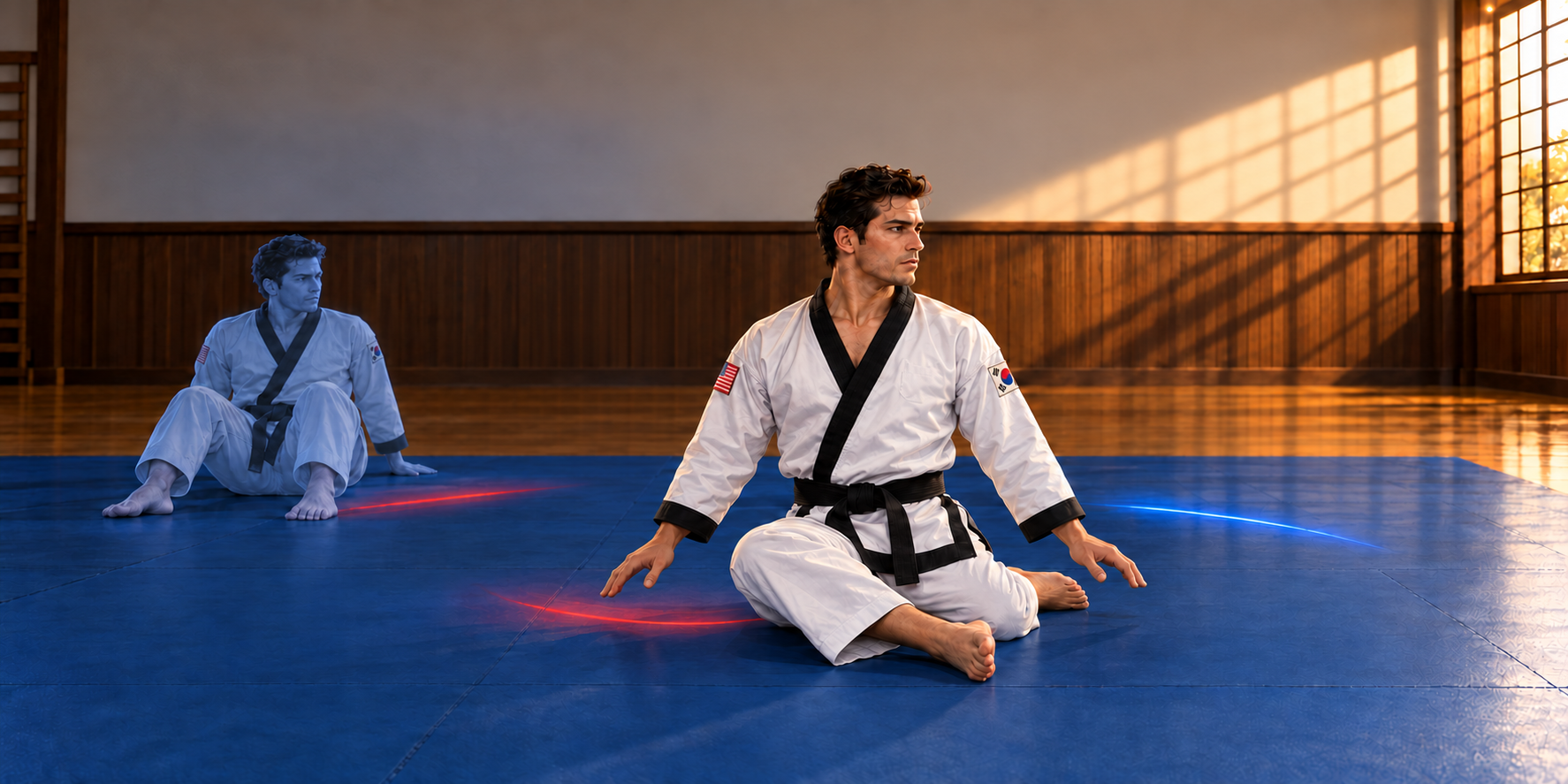
Shin-Box Transitions train the hips to rotate while the trunk remains organized. Begin seated with both knees bent at 90º and the feet comfortably apart. Lower both knees toward one side into a controlled shin-box position, return through the center, and rotate into the mirror-image position on the other side. Do this while keeping your shoulders over your hips and without having to lean backward.
The challenge is not to force both knees flat or imitate a perfect right angle. It is to move through the range your hips can control without twisting the knees, collapsing the torso, or throwing the legs with momentum.
As control improves, the hands contribute less. Advanced students add a controlled shin-box rise: from the seated position, press through the shins and knees, bring the hips forward into a tall shin stand, then lower through the same path. Every progression must remain smooth, symmetrical, and pain-free.
Remember: students must complete six weekly challenges during each testing cycle.
Coach’s Tips
- Use a clean padded or matted surface with enough space for both knees to move freely from side to side.
- Warm up with easy walking, gentle hip circles, supported knee lifts, and comfortable seated hip movement before beginning the assigned sets.
- Begin seated with the knees bent and the feet wider than the hips. Place the hands behind the body for support and sit as tall as your current mobility permits.
- Rotate both knees toward one side. Let the movement come from the hips; do not press, wrench, or pull a knee toward the floor.
- Use an approximate 90/90 shin-box shape only when it fits comfortably. The front and rear knees may remain farther from the floor, and the angles may be more open.
- Keep the feet in contact with or close to the floor during the switch. Move slowly enough to stop at any point rather than swinging through the center.
- Pause in each landing position. Reorganize the torso over the pelvis before beginning the next transition.
- One transition is the controlled movement from one shin-box side to the other. A complete repetition contains two transitions.
- Hand support is permitted at every tier. Use the palms, fingertips, yoga blocks, or a firm elevated surface as needed to maintain posture and control.
- For a shin-box rise, begin from a stable seated shin box. Press both shins and knees into the mat, engage the hips, and bring the pelvis forward into a tall shin stand. Lower slowly to the same seated position. Do not twist the knees, roll over the ankles, or use momentum.
- A supported partial hip lift counts when a full shin stand is not appropriate. Students do not need to rise to standing for this challenge.
- Avoid forcing end range. A muscular stretch is acceptable; sharp pain, pinching, joint pressure, numbness, tingling, or pain in the knee or groin means stop and reduce or omit the movement.
- Students with a recent hip or knee injury, surgery, or medical restriction should use only a clinician- or instructor-approved variation.
- Rest before posture, breathing, or control deteriorates. Quality overrides quantity.
Why This Matters
Every switch places one hip primarily into external rotation and the other into internal rotation, then reverses those rotations. Controlling the transition asks the hips to move while the trunk remains stable and the knees follow the available hip range rather than absorbing a forced twist.
The shin-box rise adds strength to mobility. Instead of remaining in a passive seated position, the practitioner must press into the floor, bring the hips forward, establish a tall posture, and return without falling. This connects hip rotation with ground movement and postural control.
Tang Soo Do requires the practitioner to change direction, turn the hips, recover from low positions, and maintain posture while the legs reorganize beneath the body. Shin-Box Transitions do not replace technical stance or kicking practice, but they develop useful movement options for those demands.
Rise Up!
Mobility is not how far you can force a joint. It is how much range you can control.
Rotate without rushing. Rise without throwing. Return without collapsing.
Bronze Tier: White & Orange Belts
Complete three sessions on separate days.
During each session, complete 3 sets of 6 transitions—18 transitions per session and 54 for the week.
- Keep both hands behind you for support.
- Move through a comfortable range and pause briefly after every landing.
- A smaller switch in which the knees do not reach the floor counts.
- Rest 30–60 seconds between sets.
Focus: Learn the movement path, protect the knees, and arrive under control on both sides.
Silver Tier: Green & Brown Belts
Complete three sessions on separate days.
During each session, complete 3 sets of 8 transitions—24 transitions per session and 72 for the week.
- Use fingertip or light hand support rather than pushing strongly through the arms.
- Pause for two seconds in each shin-box position with the torso as tall as your available range permits.
- Match the speed and controlled range of the right and left transitions.
- Complete the final two transitions of each set without hand support only when posture and knee comfort remain dependable.
Focus: Active hip rotation, reduced reliance on the hands, symmetrical range, and stable posture.
Gold Tier: Red & Blue Belts
Complete four sessions on separate days.
During each session, complete 3 rounds of:
- 8 controlled shin-box transitions
- 2 shin-box rises on the right
- 2 shin-box rises on the left
That is 24 transitions and 12 rises per session—96 transitions and 48 rises for the week.
- Perform the transitions without hand support when readiness permits; use fingertips whenever posture begins to collapse.
- Take three seconds to rise into the tall shin stand and three seconds to lower.
- Pause for one full breath at the top of every rise.
- Keep the hips and torso stable without pressing for a long and deep stretch.
Focus: Hands-free control, strength through rotational range, deliberate tempo, and an upright finish.
Master’s Tier: Black Belts
Complete the Gold Tier workload and lead through technical excellence.
- Designate one round in each session as a precision round: take three seconds for every transition, pause for two seconds in each shin box, then use the prescribed slow tempo for every rise.
- Complete one assessed round during the week. Ask a qualified practitioner to observe posture, hip-driven rotation, knee comfort, symmetry, and the controlled return from the shin stand—or record specific self-observations immediately afterward.
- Coach one student through a readiness-appropriate progression. Help the student improve one specific point of support, range, posture, or tempo without pressing the knees toward the floor or removing support prematurely.
Focus: Refined movement quality, honest assessment, intelligent scaling, and leadership through patient instruction.
Challenge Reminder
Record the date, transitions completed, rises completed, support used, and one observation about the difference between sides. Count only transitions that begin and end under control. A complete round trip contains two transitions.
Use a smaller range, more hand support, a partial hip lift, or a lower tier whenever that choice preserves safe hip rotation and knee comfort.
The challenge is due Tuesday, November 10, 2026.
Complete the challenge.
Encourage another student.
Grow stronger together.
Your Attitude Determines Your Altitude. SOAR!


