
SOAR Challenge: Single-Leg Reach Matrix

Balance • Ankle Stability • Multidirectional Control
Challenge Due: Tuesday, November 17, 2026.
DO NOT FORGET: YOU NEED TO COMPLETE SIX CHALLENGES FOR EACH TESTING CYCLE.
Balance is more than standing still. Tang Soo Do requires us to maintain control while one leg kicks, chambers, steps, pivots, or changes direction.
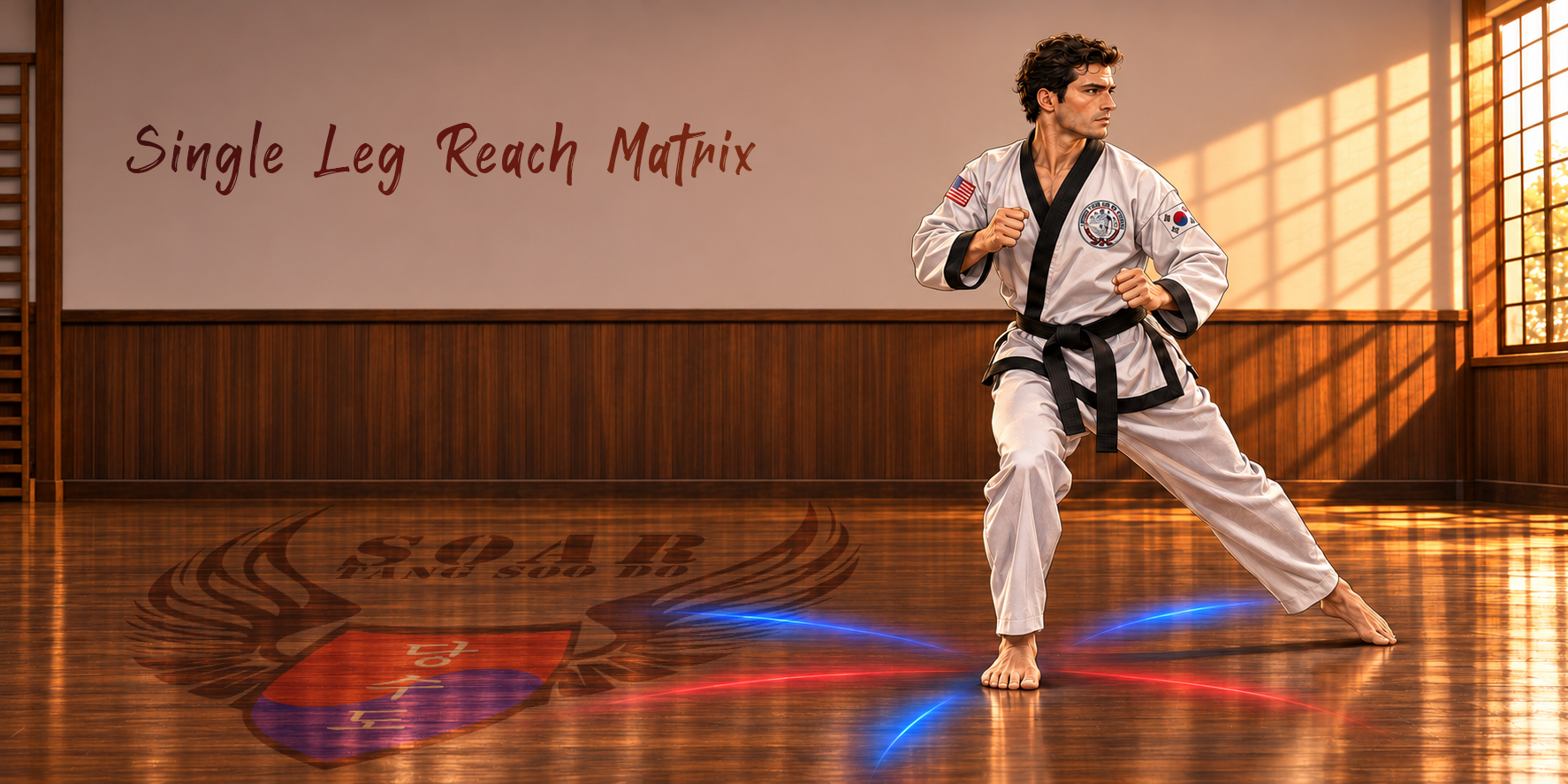
The Single-Leg Reach Matrix develops that control. Stand on one leg while the raised foot reaches lightly in five directions: forward, forward diagonal, side, backward diagonal, and backward. After every reach, return to a stable single-leg position without hopping, collapsing, or transferring weight into the reaching foot.
The goal is not to reach as far as possible. The goal is to move as far as you can while preserving control of the supporting foot, ankle, knee, hip, and torso.
Coach’s Tips
- Warm up with easy movement, ankle circles, controlled calf raises, shallow squats, and brief supported single-leg holds.
- Practice beside a wall, chair, barre, or another stable support. Use light fingertip assistance whenever it improves control.
- One matrix consists of five reaches with the raised foot: forward, forward diagonal, side, backward diagonal, and backward.
- Touch the floor lightly with the toes of the reaching foot. Do not shift your body weight onto that foot.
- Keep the supporting foot fully planted and the heel grounded.
- Let the supporting knee bend naturally and track in the same direction as the toes. Do not allow it to collapse inward.
- Keep the pelvis controlled and the torso long. A small forward inclination is acceptable; uncontrolled twisting or folding is not.
- Return to a stable single-leg position after every reach. Establish balance before beginning the next direction.
- Shorten the reach, reduce the supporting-knee bend, or use hand support when balance or mobility limits the full movement.
- Do not add unstable surfaces, closed-eye work, speed, or external weight to this challenge.
- Stop if you experience joint pain, repeated ankle rolling, dizziness, or an inability to control the supporting knee. Students recovering from a lower-extremity injury should use an instructor-approved modification and follow any medical guidance already provided.
Quality overrides distance.
Why This Matters
A kick begins and ends on one supporting leg. If that leg cannot stabilize the foot, ankle, knee, hip, and trunk, the chamber becomes unstable, the striking surface becomes inconsistent, and the return becomes difficult to control.
Multidirectional reaching also reveals differences between sides. One direction may feel stable while another exposes limited ankle motion, weak hip control, or poor awareness of the supporting knee. Those differences are information—not an invitation to force additional range.
Reach-based single-leg tasks are used in research and clinical practice to examine dynamic postural control. Training studies have also reported improvements in reach-based balance performance after progressive balance practice. This challenge adapts that general movement pattern for controlled martial-arts conditioning; it is not a medical assessment.
Rise Up!
Stand tall before every repetition.
Reach without abandoning your base. Return without rushing. Train the supporting leg with the same attention you give the kicking leg.
Control the center, and the movement around it becomes stronger.
Bronze Tier: White & Orange Belts
Complete three sessions on separate days.
During each session:
- Complete 2 matrices while standing on the right leg.
- Complete 2 matrices while standing on the left leg.
- Each matrix contains five controlled reaches.
- Complete 10 reaches per leg and 20 total reaches per session.
Use light hand support as needed. Reset both feet between directions if maintaining continuous single-leg balance is not yet appropriate.
Focus: Learn the five directions, keep the supporting foot planted, and return to balance after every reach.
Silver Tier: Green & Brown Belts
Complete three sessions on separate days.
During each session:
- Complete 3 matrices while standing on each leg.
- Complete 15 reaches per leg and 30 total reaches per session.
- Return to the single-leg starting position and hold your balance for one full second after every reach.
Use a reach distance that allows the supporting knee to remain aligned with the foot.
Focus: Consistent knee tracking, controlled depth, and equal practice on both sides.
Gold Tier: Red & Blue Belts
Complete four sessions on separate days.
During each session:
- Complete 4 matrices while standing on each leg.
- Complete 20 reaches per leg and 40 total reaches per session.
- Pause for two seconds at each light toe touch.
- Return to the starting position without hopping or setting the free foot down between directions when readiness permits.
Designate the final matrix on each leg as a precision matrix. Move deliberately and make every return as controlled as the reach.
Focus: Multidirectional strength, longer controlled reaches, stable returns, and technical consistency under fatigue.
Master’s Tier: Black Belts
Complete the Gold Tier workload and lead through technical excellence.
- During each session, perform one slow-control matrix per leg: take three seconds to reach, pause for two seconds, and take three seconds to return in every direction.
- Complete one assessed matrix during the week. Ask another qualified practitioner to observe the supporting foot, knee tracking, pelvic control, reach distance, and return to balance. Record one specific observation for each leg.
- Coach one student through a readiness-appropriate matrix. Help the student improve one point of alignment or control without increasing distance prematurely.
Focus: Deliberate control, honest assessment, bilateral consistency, intelligent scaling, and leadership through patient instruction.
Record each session, the number of matrices completed, whether support was used, and one observation about each leg.
A student may use a shorter reach, shallower knee bend, hand support, or lower-tier volume regardless of belt rank when that choice preserves safe and controlled movement.
Complete the challenge.
Encourage another student.
Grow stronger together.
Your Attitude Determines Your Altitude. SOAR!


