
SOAR Challenge: Cossack Squats

Lateral Strength • Active Mobility • Full-Range Control
Challenge Due: Tuesday, November 24, 2026.
DO NOT FORGET: YOU NEED TO COMPLETE SIX CHALLENGES FOR EACH TESTING CYCLE.
Most of our daily movement travels forward and backward. Tang Soo Do, however, requires us to control our bodies while stepping, shifting, defending, and changing direction laterally.
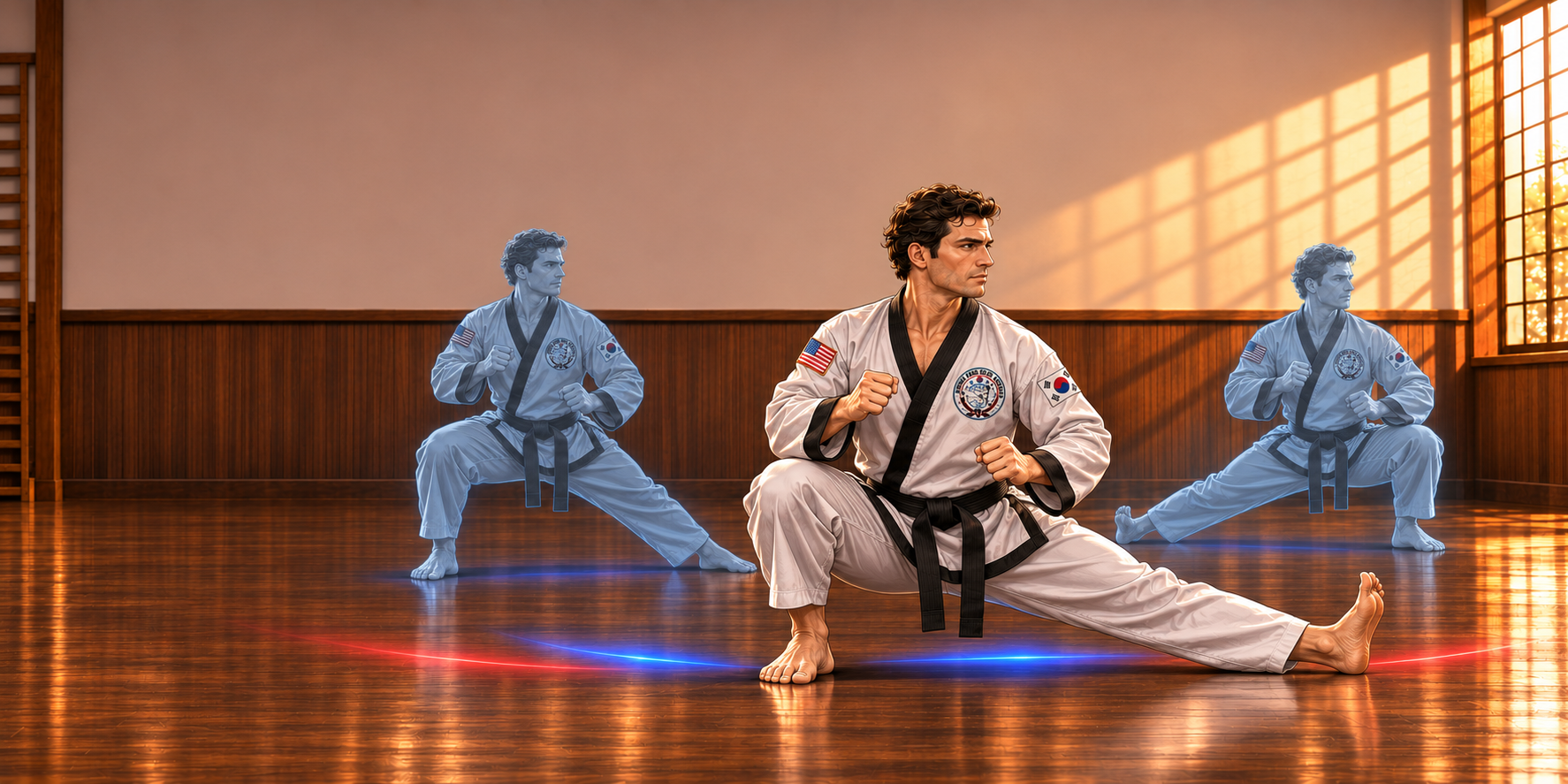
The Cossack Squat develops strength and mobility through that side-to-side range. Begin in a wide stance. Shift your weight toward one leg as that knee bends and the hips travel back and down. The opposite leg lengthens while its heel remains grounded. Return to the center under control, then repeat on the other side.
Depth is not the standard. Control is the standard.
A shallow, well-aligned repetition is more valuable than a deep position that twists the knee, lifts the working heel, or requires momentum to escape.
Coach’s Tips
- Warm up with 5–10 minutes of easy movement before beginning. Include shallow squats, lateral weight shifts, ankle movement, and gentle hip preparation.
- Begin with a stance only as wide as you can control. A wider stance is not automatically better.
- Shift toward one leg while keeping that foot planted. Let the knee track in the same direction as the toes.
- Move the hips back and down. Keep the spine long and shoulders over hips. A small forward torso inclination is normal; uncontrolled rounding or collapsing is not.
- Keep the opposite knee comfortably straight without forcing it into hyperextension.
- Keep the heel of the extended leg grounded. The toes may rotate upward naturally as the range increases, but do not wrench the foot or knee into position.
- Return to the center by pressing through the working foot. Do not bounce out of the bottom or use momentum.
- One repetition consists of descending toward one side and returning to the centered wide stance.
- Use a chair, barre, post, or other stable support for balance whenever needed.
- Reduce the depth, shorten the stance, or perform a supported lateral squat to a high box or bench when the full movement is inappropriate.
- Do not add external weight during this challenge.
- Stop if you experience sharp pain, groin pain, joint pain, numbness, or an inability to keep the working knee aligned.
- Students recovering from a hip, groin, knee, or ankle injury should use an instructor-approved modification and follow any medical restrictions already provided.
Quality overrides depth.
Why This Matters
A Cossack Squat asks one leg to produce force while the other side lengthens under control. The hips, knees, ankles, and trunk must cooperate through a lateral range that ordinary forward squats do not emphasize as strongly.
That combination supports the physical qualities used when changing direction, widening or narrowing a stance, shifting away from an attack, recovering balance, and moving smoothly between positions.
This is not passive stretching. The student must remain strong enough to enter the range, control it, and return from it.
The Cossack Squat is a general conditioning exercise. Its value comes from developing usable lateral range while preserving alignment and control.
Rise Up!
Build the range you can control today. Let strength, patience, and consistent practice deepen that range over time.
Move to the side with purpose. Return to center with discipline.
Bronze Tier: White & Orange Belts
Complete three sessions on separate days.
During each session:
- Complete 2 sets of 4 repetitions per side.
- Complete 8 repetitions per side and 16 total repetitions per session.
- Rest 45–90 seconds between sets.
- Use hand support, a shorter stance, a high box, or a shallow range whenever needed.
Return to the centered stance after every repetition. Reset your feet between sides if continuous transitions reduce control.
Focus: Learn the lateral weight shift, keep the working foot planted, and maintain knee alignment.
Silver Tier: Green & Brown Belts
Complete three sessions on separate days.
During each session:
- Complete 3 sets of 5 repetitions per side.
- Complete 15 repetitions per side and 30 total repetitions per session.
- Pause briefly at the deepest controlled position before returning to center.
- Use support when it improves alignment or permits a smoother return.
Alternate sides only when you can cross the center without bouncing or twisting either knee.
Focus: Bilateral strength, smooth transitions, and consistent alignment through a readiness-appropriate range.
Gold Tier: Red & Blue Belts
Complete four sessions on separate days.
During each session:
- Complete 3 sets of 6 repetitions per side.
- Complete 18 repetitions per side and 36 total repetitions per session.
- During the final set, pause for two seconds at the deepest controlled position of every repetition.
- Return to center without using the hands, lifting the working heel, or collapsing the torso when readiness permits.
Do not increase depth during a set if fatigue begins to alter the foot, knee, hip, or trunk position.
Focus: Active range, controlled strength near the end of that range, and consistent movement under fatigue.
Master’s Tier: Black Belts
Complete the Gold Tier workload and lead through technical excellence.
- During each session, designate one set as a slow-control set. Take three seconds to descend, pause for two seconds, and take three seconds to return on every repetition.
- Complete one assessed set during the week. Ask another qualified practitioner to observe stance width, heel contact, knee tracking, torso control, depth, and return to center. Record one specific observation for each side.
- Coach one student through a readiness-appropriate variation. Help the student improve one observable detail without forcing greater depth or removing needed support.
The slow-control work is included within the Gold Tier repetitions; it is not additional volume.
Focus: Strength throughout the available range, honest self-assessment, intelligent scaling, bilateral consistency, and leadership through patient instruction.
Record each session, repetitions completed, support used, and one observation about your left and right sides.
Complete the challenge. Encourage another student. Grow stronger together.
Your Attitude Determines Your Altitude. SOAR!


