
SOAR Challenge: Ground-Flow Kick-Throughs

Coordination • Mobility • Rotational Control
Challenge Due: Tuesday, October 20, 2026.
DO NOT FORGET: YOU NEED TO COMPLETE SIX CHALLENGES FOR EACH TESTING CYCLE.
Tang Soo Do normally asks us to control movement while standing. This week, we take that same discipline to the floor.
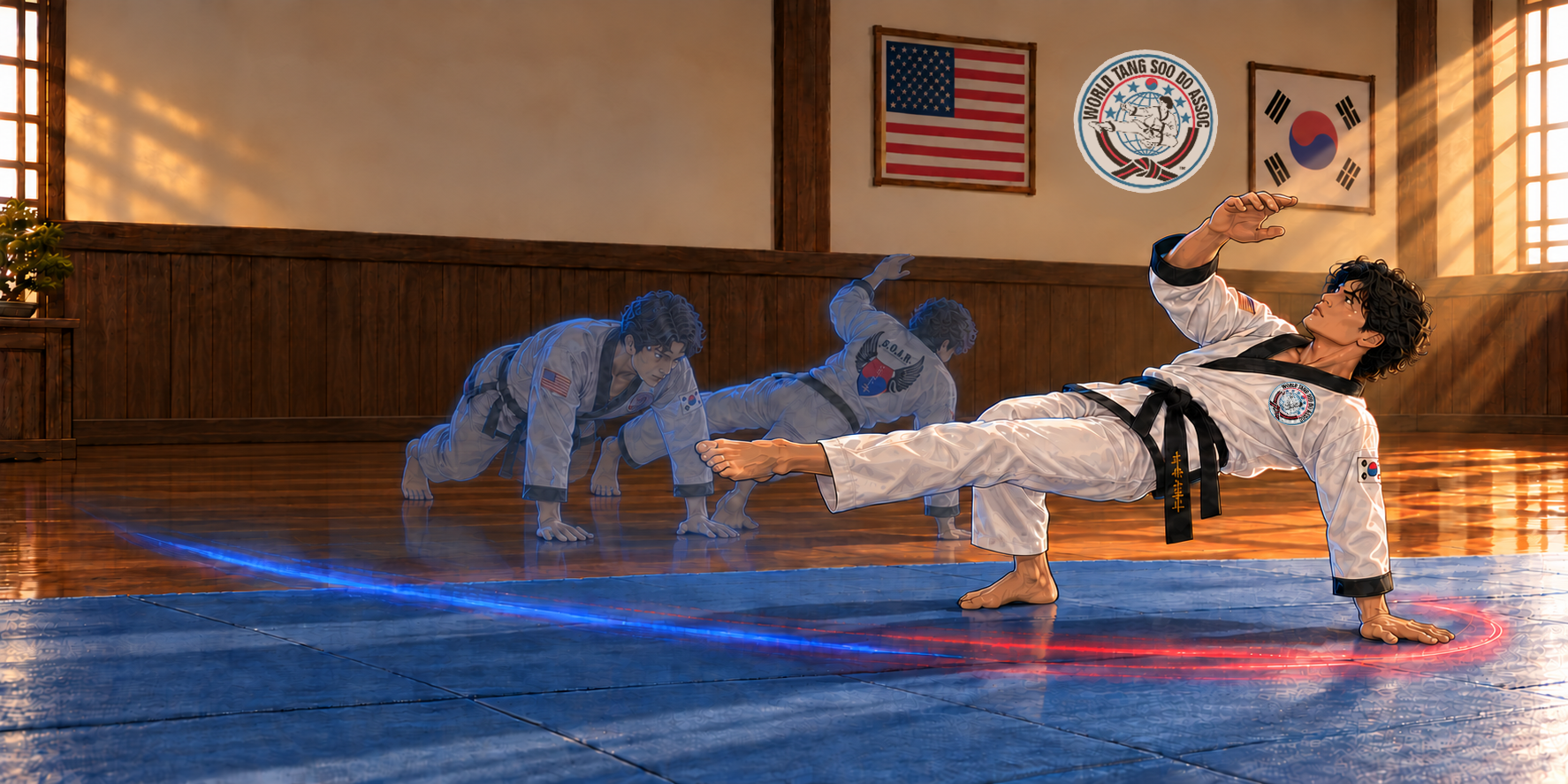
The Ground-Flow Kick-Through begins in a strong quadrupedal position: hands beneath the shoulders, toes on the floor, knees hovering beneath the hips, and the trunk braced. From there, the practitioner shifts weight into one hand and the opposite foot, rotates under control, and extends the free leg across the body. The movement then reverses until the starting position is recovered.
This is a conditioning exercise that develops qualities useful to martial movement: shoulder stability, trunk control, hip rotation, coordination, and the ability to move smoothly near the ground. The challenge is to connect each position without collapsing, rushing, or forcing range.
Coach’s Tips
- Use a clean, padded, nonslip training area with enough space to extend a leg safely in either direction.
- Warm the wrists, shoulders, trunk, and hips before beginning. Start with easy wrist rocks, shoulder-blade movement, quadrupedal weight shifts, and slow hip rotations.
- Begin on hands and knees with hands beneath the shoulders and knees beneath the hips. Spread the fingers and press through the whole hand rather than sinking into the wrist.
- Tuck the toes and lift the knees only a small distance from the floor. Keep the spine long, ribs controlled, and hips low enough to remain stable.
- To extend the right leg, shift weight into the right hand and left foot, lift the left hand, and pass the right leg beneath the body. Reverse those relationships for the left leg.
- Rotate the hips and trunk together. Do not wrench the knee, force the planted foot to remain fixed, or throw the leg farther than the supporting shoulder can control.
- Keep the supporting shoulder active by pressing the floor away. Do not hang passively into the joint or allow the shoulder to collapse toward the ear.
- Extend the kicking leg only through a range that permits a controlled return. A low toe tap, bent-knee thread-through, or short extension counts when it matches readiness.
- Return the extended leg beneath the body, replace the lifted hand, and recover the quadrupedal position before beginning the next repetition.
- One completed extension and controlled return counts as one repetition. Train both sides equally.
- Move slowly enough to stop at any point. Speed is added only after the hand, shoulder, trunk, hips, and supporting foot remain dependable.
- Use short sets and rest before wrist pressure, shoulder fatigue, or loss of trunk control changes the movement.
- Modification: keep both knees on the floor and practice only the weight shift and rotational reach. A stable elevated surface may also reduce the wrist and shoulder demand.
- Stop for sharp pain, numbness, tingling, dizziness, joint pressure, or unsafe loss of control. Quality overrides quantity.
Why This Matters
A kick-through coordinates opposite sides of the body. One hand and the opposite foot support the practitioner while the free arm and leg move through space. The shoulders must stabilize, the trunk must resist collapse, and the hips must rotate without losing the ability to return.
Those demands complement Tang Soo Do training. Stronger shoulder support can improve ground transitions. Controlled hip rotation can make directional changes smoother. Better trunk control helps the hands and legs move without pulling the body out of balance.
The most important part of the repetition is not how far the leg travels. It is whether the practitioner owns the entire path—from the starting hover, through the rotation, and back to a stable base.
Rise Up!
Bronze Tier: White & Orange Belts
Beginner progression: complete 3 sessions on separate days.
During each session, complete 3 sets of 4 kick-throughs per side—24 repetitions per session and 72 for the week.
- Begin from hands and knees or a low knee hover.
- Use a bent-knee thread-through or low toe tap.
- Replace the hand and reset both knees or the hover position after every repetition.
- Rest 30–60 seconds between sets.
Focus: Learn the support pattern, protect the wrists and shoulders, and return to a stable starting position.
Silver Tier: Green & Brown Belts
Advanced progression: complete 3 sessions on separate days.
During each session, complete 3 sets of 6 kick-throughs per side—36 repetitions per session and 108 for the week.
- Begin from a controlled knee hover.
- Extend the passing leg toward straight without forcing range.
- Pause briefly in the open position, then return and establish the hover before changing sides.
- Keep the knees off the floor during each set when readiness permits.
Focus: Full-body coordination, active shoulder support, and controlled hip rotation.
Gold Tier: Red & Blue Belts
Expert progression: complete 4 sessions on separate days.
During each session, complete 3 sets of 8 kick-throughs per side—48 repetitions per session and 192 for the week.
- Alternate sides continuously without placing the knees down between repetitions.
- Extend the leg fully only when the planted hand, shoulder, and opposite foot remain stable.
- Let the free arm move into a balanced guard or controlled reach without pulling the shoulder or trunk out of alignment.
- Designate the final set as a precision set: pause for one second in every extended position and one second in every recovered hover.
Focus: Continuous flow, change of direction, usable range, and control under fatigue.
Master’s Tier: Black Belts
Master’s progression: complete the Gold Tier workload and lead through excellence.
- Complete one slow-control set during each session: take three seconds to extend, pause for one second, and take three seconds to return on every repetition.
- Complete one assessed set during the week. Ask another qualified practitioner to observe the supporting shoulder, trunk position, hip rotation, and return to base—and record those observations immediately after the set.
- Coach one student through the readiness-appropriate progression. Help the student improve one specific point of support or control without increasing range or speed prematurely.
Focus: Precision through the full path, honest self-assessment, intelligent scaling, and leadership through patient instruction.
Weekly Challenge Reminder
Record each session, repetitions per side, progression used, and one technical observation. A student may use a lower progression or reduced volume regardless of belt rank when that choice preserves safe, controlled movement. The challenge is due Tuesday, October 20, 2026.
Complete the challenge. Encourage another student. Grow stronger together.
Your Attitude Determines Your Altitude. SOAR!


